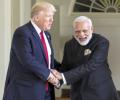
Now, the NDAA needs to be passed by the Senate before it can be sent to the White House for the US President Donald Trump to sign into law.

The disengagement process between India and China in eastern Ladakh is in final stages and on the brink of completion, top officials of the country's defence establishment on Thursday told a parliamentary panel during a meeting, which sources said turned 'stormy' amid several questions asked by opposition members including Congress leader Rahul Gandhi.

This was the one Budget that required radical departures on all these fronts, when it had none, asserts, Shreekant Sambrani.
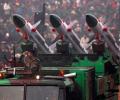
Defence experts want defence expenditure to be at 3% of GDP, which they consider minimum to counter the two-front threat from China and Pakistan, internal insurgencies, and dominating a 7,500 km coastline and the Indian Ocean beyond. What Arun Jaitley has given India this Budget is 2.16% of GDP, observes Ajai Shukla.

The session will commence with the maiden address of President Droupadi Murmu to the joint sitting of both Houses of Parliament. The address essentially highlights the government's achievements and policy priorities.

Elections are not won or lost by expounding on such macro-economic matters. For the aam admi, what matters in manifestos are promises that will improve their quality of life, notes Vinayak Chatterjee.
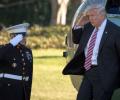
Speaking at a bipartisan gathering of US governors at the White House, Trump vowed significant increase in defence law enforcement and law enforcement. "This budget will be a public safety and national security budget," Trump said.

In the event of the BJP's poor performance in the assembly polls this year and in early 2025, Modi's hold will get further weakened because he will no longer remain the invincible electoral persona tightly controlling the machine at his disposal, asserts Nilanjan Mukhopadhyay.

The defence sector is seeing renewed interest by Indian corporates, says Jyoti Mukul

Former Prime Minister Indira Gandhi was the first and only women till now to have presented the Union Budget.

'Surely, Syrian President Bashar al-Assad will not be able to pay or compensate the Russians for deployment and use of Russian men and equipment,' says Brigadier S K Chatterji (retd).

United States President Barack Obama has signed into law the $618 billion defence budget for 2017, which enhances security cooperation with India and conditions nearly half of the funding to Pakistan on a certification that it is taking demonstrable steps against the Haqqani Network.

The government is set to divest its shareholdings in defence PSUs, Garden Reach Shipbuilders & Engineers Ltd and Mishra Dhatu Nigam Ltd (MIDHANI). It will also divest its shareholding in BEML Limited, said Shripad Naik. Minister of State for Defence, on Monday. The government has invited preliminary bids to sell its 26 per cent stake in BEML along with transfer of management control.
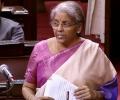
She said that despite government scheme and initiatives ranging from roads to agriculture, housing, scholarships to electricity benefiting lives of people, a false narrative was being created by the opposition that the government was working for cronies.

The 1.4% decline projected for 2025 is driven by a 5.6% (72,000) dip in the strength of railway employees to 1.2 million by next year.

The budget-making exercise offers golden opportunities despite challenges, observes Shankar Acharya, former chief economic adviser to the Government of India.
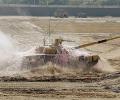
'India should take up defence manufacturing in a more serious manner and encourage greater private participation.'
The Modi government is notoriously honest about one fact: It does not listen to economists, observes Shekhar Gupta.

Describing the DAD as the "guardian of defence finance", he emphasised the need to bolster the internal vigilance mechanism so that any suspicious activity can be detected and reviewed immediately.
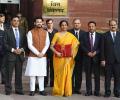
'There is a time for lowering one's expectations of the economy -- and therefore not trying to do too much in the Budget,' notes T N Ninan.

According to an Andhra government statement, Naidu 'reposed confidence' in the PM's leadership.

The 54-page document tabled in Parliament detailed how the Modi-government pull the economy from being counted among the most fragile-five in the world to being the fasted growing and the most attractive investment destination.

As remarkable as DRDO's contribution in containing and treating COVID-19 has been, its success over the last 15 months has been in its primary role of developing conventional defence equipment and technologies.
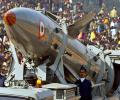
The ministry of defence has set a goal of $26 billion, including export of $7 billion for the industry by 2025-26 through its Defence Production Policy 2018.

'It is crucial today to realise where we have reached in this 15 year-period in order to fully and properly assess the profundity of what General Rawat has said,' points out Ambassador M K Bhadrakumar.
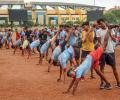
The greatest unknown in this risky initiative lies in the way human relationships will play out -- not just between the Agniveers, who will be competing with their fellows for permanent jobs beyond their four-year tenures -- but also between the Agniveers and existing full-time soldiers, warns Ajai Shukla.

Budget 2018 bears imprints of a government unsure of second term with clear majority, says Shekhar Gupta.

But the government will present a second tranche of Supplementary Demands for Grants during the Budget session of Parliament in February, when it can seek additional spending.

You don't prep for 2028 but for 2040, or even 2044. Sustained sporting excellence is based on mass support, grassroots development, and funding - and it is this trifecta India needs to work on, systematically, asserts Prem Panicker.
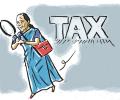
The continuing fiscal stimulus is heavily tilted towards capex, to the extent that it chips away a part of revenue spending. Accounting for other areas of revenue expenditure, such as salaries, pensions, subsidies and defence (committed spend), the room to spend on welfare schemes, health and education will narrow in FY22.

Ironically, rival Tamil Nadu governments expend the most on social welfare schemes, especially targeting women and youth and children, but that money comes only by selling more liquor. There is always the specious plea, which has been peddled very many times in the past, that without licensed liquor, drinkers would go after hooch and there could be more hooch tragedies and hooch deaths. No one is convinced, but no one can dispute it either, comments N Sathiya Moorthy.

This includes over $15 billion of proposed investment in the infrastructure sector in the Indo-Pacific and $9 billion for shoring up American defence in the region.

A piece of slightly negative news can cause a serious setback, warns Debashis Basu.

"This is the single reason why the country did not have a CDS so far," the former army chief said.

The gross domestic savings rate increased from 29.8 per cent in 2003-04 to 30.7 per cent in 2007-08. The tax to GDP ratio increased from 9.2 per cent 2003-04 to 4.5 per cent 2007-08, Pranab Mukherjee said.

A large number of items including petrol, diesel, gold, silver, cigarettes, fully-imported cars and split air conditioners will become more expensive due to hike in taxes, as proposed by Finance Minister Nirmala Sitharaman in the Union Budget for 2019-20.

The government should keep the interest of unemployed youth paramount and bring out various policy aspects of this initiative, Varun said.
Forget about interim Budgets, one cannot easily recall even a full Budget of any government in recent times having rolled out benefits of this order to such a large number of people, says A K Bhattacharya.

The CDS will be a four-star general and his salary will be equivalent to that of service chiefs.
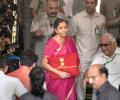
As India emerges from the COVID-19 crisis, the ninth budget under the Modi government, including an interim one, is widely expected to focus on boosting spending on job creation and rural development, generous allocations for development schemes, putting more money in the hands of the average taxpayer and easing rules to attract foreign investments.
 © 2026 Rediff.com - Advertise with us - Disclaimer - Privacy Policy - Sitemap - Feedback - About us - Terms of use - Grievances